
I was talking with a custom fabrication shop owner this week about the struggle of training new fabricators to grow the business.
The work takes a high level of specialized skill. Every job is a little different. You can't hand somebody a checklist and expect perfect welds. A fabricator has to think 20 steps ahead and really understand how the components work together in the final product.
I get it. I've managed a shop where orders need to get out the door, experienced people are stretched thin, and training feels like something you just don't have time for. It feels like you can't slow down to train without wrecking your margins or making customers angry.
You might be right. You might not be able to do it alone. But you can build a training system that makes it easier:
- Show people what good work looks like.
- Explain the setup.
- Let them shadow and watch.
- Coach them, then give them time to practice. Keep coaching.
- Check their work before a mistake turns into hours of rework.
- Build their skills in stages.
“But Taylor, I can't document how we make this product. We just make it. You have to know how it works!”
Maybe you can't. But a good technical writer can work through it with your team, document the steps, and capture even the most complicated processes.
You might look at a job and immediately know how to tackle it. A new fabricator doesn't have your years of experience or the tribal knowledge of your products. That knowledge has to come out of your head and become something you can teach.
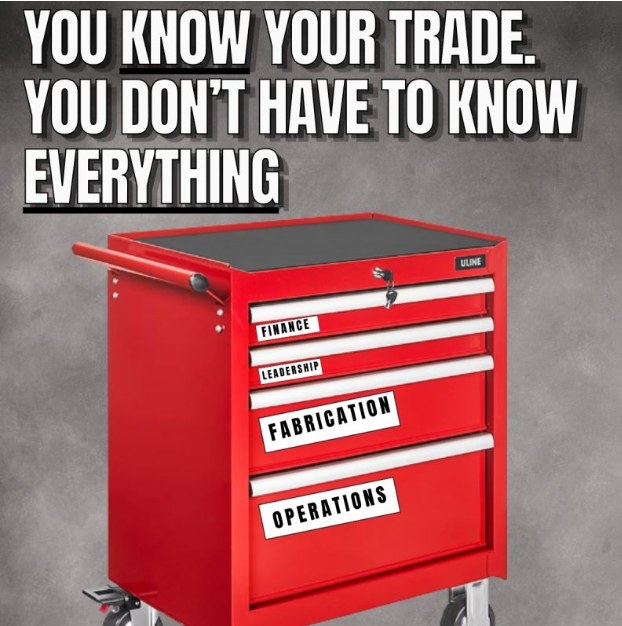
Being good at your trade doesn't mean you have to possess every skill required to scale your business.
You can be a great fabricator and still need help developing training, organizing inventory, or managing a growing team. It's okay not to know how to do everything.
At some point, growing the business means bringing in people who know things you don't, and trusting them. That can be hard when you've built the place from the ground up and you're used to figuring it out yourself. But doing everything yourself gets harder with every person you hire and every order you take.
I've struggled with it too. When you care about the work, it's easy to fall into “I'll just do it myself.” The hard truth is that you can't keep adding work to your own plate and expect the business to grow beyond what you can personally carry.
You don't have to have every answer. You do have to be willing to let someone add a few tools to your operational toolbox.
Originally shared on LinkedIn.

Taylor Ehlmann is an operations leader and ISO 9001:2026 Lead Auditor who writes about building processes and teams that keep getting better. More about Taylor